
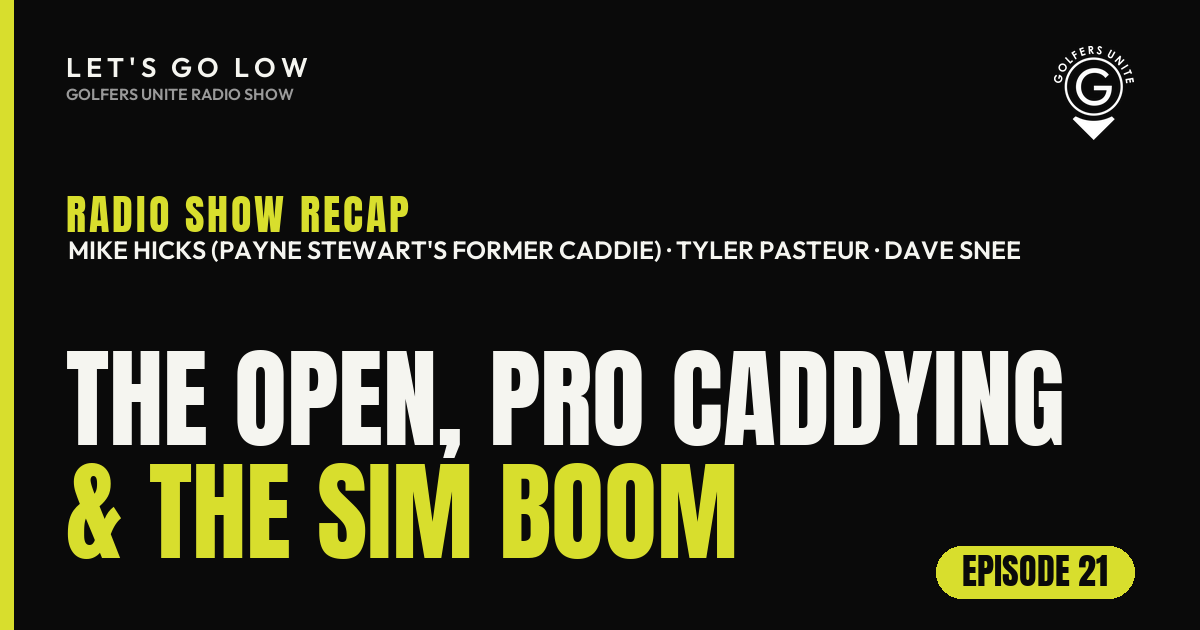
The Open is at Royal Birkdale this week, and we couldn’t have asked for a better guide: Mike Hicks caddied 18 consecutive Opens and calls it his favorite major — right before cheerfully calling the course gimmicky. Then Tyler Pasteur on what it actually takes to break into professional caddying when there’s no pathway to follow, and Dave Snee on why simulator golf is pulling in a wave of players who’ve never set foot on a real course.
Here’s what went down on Episode 21.
▶️ Watch the full episode on YouTube
Caddie Corner: The 154th Open at Royal Birkdale
Royal Birkdale is hosting The Open for the 11th time — more than any venue except St Andrews. Mike’s verdict, delivered with real affection: it’s quirky. The fairways are bumpy, it sits right on the coast, and the wind does whatever it likes.
We got into the naming, too. It’s been drifting from “the British Open” to simply The Open for years, and Mike’s read is that the organizers are deliberately elevating the brand to mark it as the premier major. Both of us landed in the same place: winning The Open — especially at St Andrews — is the pinnacle of the sport.
On the forecast: roughly a 10% chance of rain and temperatures in the low-to-mid 70s. Mike wasn’t buying it. Weather reports in that part of England are famously unreliable, and regardless of what the app says, the course will play firm, fast and bouncy.
What’s changed: the old par-5 15th is now a 241-yard par 3. From a caddie’s chair, Mike says that’s actually less work — the job collapses down to the green and its surrounds rather than plotting a way down a long hole.
Gimmicky vs. purist. Mike’s example is the 7th — the “donut hole” — where a drive straight down the middle can still bounce into the rough. That’s the definition of quirk. For contrast, he points to Muirfield and Turnberry: courses where what you see is what you get, and a good shot is rewarded like one.
On Scottie Scheffler’s missed cut at the Scottish Open — his first in 79 starts — Mike called it a possible blessing in disguise. It freed him to get to Birkdale early, adjust to the time zone, and play the course in different winds with nobody around. That’s not nothing on a links.
He also flagged something about development: American juniors tend to grow up on soft, benign setups, while players raised on links learn to play along the ground and handle wind and rain as a matter of course. At a championship like this, that’s an edge.
The pick: Tommy Fleetwood — provided the putter behaves.
Recorded Monday, July 13, before the championship began.
▶️ Watch the full episode on YouTube
Guest Segment: Breaking Into Pro Caddying, with Tyler Pasteur
There is no application form for becoming a tour caddie. That’s the honest, slightly uncomfortable premise of this one.
Tyler Pasteur has five years in — he started at TPC Scottsdale and has spent the last two seasons at Butler National in Chicago, with loops on the Korn Ferry and Epson tours. No certification course, no credential to point at. Just reps and conviction.
The traditional route, he says, is to wait in tournament parking lots hoping to catch a bag. It’s “old school,” and it’s financially brutal — you’re covering your own travel and lodging on the chance of work that may not materialize. It doesn’t scale, and it doesn’t last.
So he’s trying to build a better path:
- Cold-emailing agents — which has produced replies, though no firm offers yet.
- Building a digital presence through social media and the Verified Caddy Network, the app he’s developing with Tim Palmer — the Looper Talk guest from Episode 19. The idea is a LinkedIn-style resume for caddies: something to point at that isn’t just a handshake.
His ideal player? Young and hungry, someone who wants to win rather than collect a cheque. As Jeff put it, the money tends to be a byproduct of the partnership — not the point of it.
On style: “short and simple.” Tyler’s background is in the psychology of golf, and he sees the job as managing the mental side — being a calming presence so the player can just swing the club. On green reading, he skips systems like AimPoint in favor of instinct, feel and visualization: rolling the ball with his hand, using a foot to gauge the line. Over-analyzing a putt, in his view, is counterproductive.
Jeff’s offering to connect him with Mike Hicks — who’s worked the same courses Tyler has.
▶️ Watch the full episode on YouTube
Guest Segment: Inside the Simulator Golf Boom, with Dave Snee
Here’s the number that frames this whole segment: roughly 40% of simulator golfers have never played traditional golf. Dave Snee sees it confirmed every day — and it lines up with what we wrote about the indoor golf boom in Florida.
Dave is a former Navy Captain turned small-business owner — a transition he describes as a genuine learning curve, going from having a supporting staff to personally doing every job in the building, cleaning included. He opened Back Nine Carrollwood to about 130 people, with backing from the Carrollwood Area Business Association and local small businesses, and has since grown past 60 members against a 120-member cap.
His case for the simulator bay is a case about intimidation:
- Nobody’s watching. A private bay means beginners can be bad in peace — the single biggest barrier to starting.
- Nothing to lose. No balls in the water, no clubs against a rock.
- No expensive kit required to walk in and play.
- It’s fast. Four people can get around 18 holes in roughly two hours.
- There’s a mulligan button. Which, honestly, more of golf could use.
It’s also an entertainment room. Dave described a soccer watch party where eight guests ran two-man scrambles on the screen between action — seating pulled into the bay, living-room style, with the neighboring bays still playing golf. You can also order Chick-fil-A from next door straight to your bay, which feels like cheating in the best way.
One story worth flagging: local homeschooling families are using the facility for PE credit, and one secured state funding for their membership through Florida’s Step Up program. Dave wants more families to know that’s on the table.
The industry news: Full Swing — the simulator tech Back Nine runs, and the official simulator of the TGL league — was acquired by Versant for $530 million. Because Versant also owns Golf Now, Back Nine Carrollwood will integrate with the Golf Now platform for online tee-sheet management and hot deals. Dave reads the acquisition as serious investment behind Full Swing, cementing it as a major player in the space.
▶️ Watch just this segment: Watch the full episode on YouTube
Watch, Listen & Join
Catch Let’s Go Low every Saturday, and subscribe on YouTube so you never miss a Caddie Corner.
Golfers Unite members get exclusive deals from 18+ golf brands — and it’s free to join. Get the hookup →
Follow us: Instagram/TikTok @whengolfersunite · X @golfers_unite
Let’s Go Low. ⛳
